

A few days ago, I posted a Substack Note that got wayyyyyyy more traction than I expected it to.
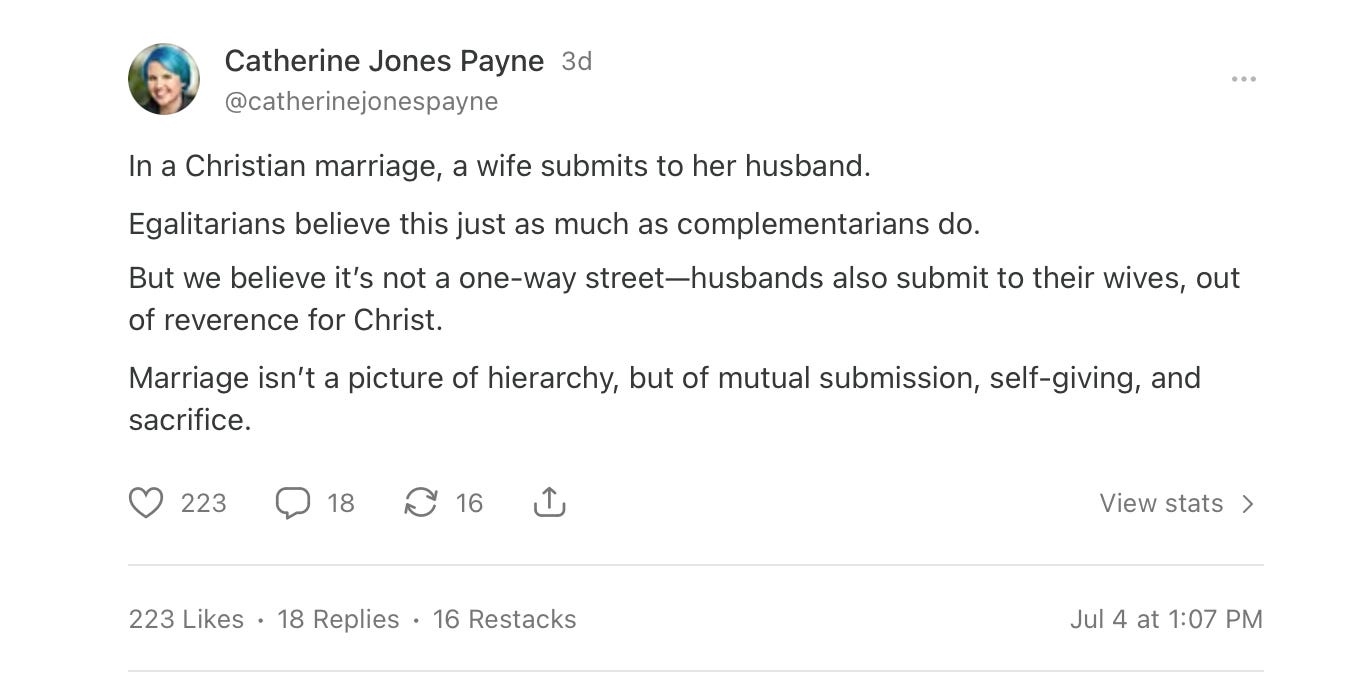
I knew not everyone would agree with me, but I didn’t think it was an especially hot take. In fact, I thought I was offering an olive branch of sorts to complementarians, saying that we agree on more than is usually assumed.
It didn’t go over that way.
I think I got more pushback on that Note than I have on anything else I’ve posted on Substack. I got so much pushback that a couple of my friends messaged me about the pushback I was getting! But—as is typical of my corner of Substack—(almost) all my interlocutors were thoughtful and polite, so I’m grateful that they took the time to engage.
The sort of objections that they were raising were bigger than what can be hashed out in the comments section of a Note on a holiday weekend. So I decided to launch a six-week series on the household codes in Ephesians 5:21–6:9 and Colossians 3:18–4:1. (There’s a lot to cover!) These verses contain instructions for husbands and wives, children and parents, and slaves and masters in the churches in Ephesus and Colossae.
As is undoubtedly already obvious, I approach these passages as an egalitarian.1 But I try to handle the text as evenhandedly as I can. My goal here isn’t to make you an egalitarian. If you’re a firm complementarian, know that you’re welcome to join us on this ride. I hope that, by the end of this series, we’ll all understand the household codes better than we did when we started. And maybe we can even build some common ground and mutual understanding along the way!
What Are the Household Codes?
In Ephesians 5:21–6:9 and Colossians 3:18–4:1, Paul addresses three pairs of household relationships—wives and husbands, children and parents, and slaves and masters. Each passage goes something like this:
Wives, submit to your husbands.
Husbands, love your wives.
Children, obey your parents.
Parents, do not provoke your children.
Slaves, obey your masters.
Masters, don’t threaten your slaves.
They’re essentially mini manuals of household order, answering this question: “What should relationships look like in a Christian household?”
Consistency Is Key
Here’s the biggest mistake that I think most twenty-first-century Christians—complementarians and egalitarians alike—make when reading the household codes: We pull them apart, as if we can separate out each of the three pairs and pick and choose the ones that “still apply.”
Almost everyone agrees that the instructions to slaves/masters don’t apply literally to today. (Some people try to draw parallels to employee/employer relationships, but we don’t think that these verses permanently endorse the institution of slavery.)
Almost everyone agrees that the instructions to children/parents do apply literally to today. It seems like common sense. Kids and teens need the guidance of their parents because their brains aren’t fully formed, right?
And when it comes to wives/husbands, there isn’t a broad consensus—some Christians believe that these passages endorse hierarchy and/or one-way submission in all times and cultures, while others don’t.
But there’s a pretty big problem with this framing—regardless of where you land on the husband-wife relationship. The Ephesians passage and the Colossians passage are each a single literary unit. We can’t pull them apart like … well, cinnamon pull-aparts. If we want to take the text seriously, we must use the same interpretive principles when interpreting and applying each pairing. If we find ourselves using different exegetical methods for wives/husbands, children/parents, and slaves/masters, we’re not interpreting the text on its own terms.

“Okay,” you might say. “The husband/wife relationship is a picture of Christ and the church, and the parent/child relationship is grounded in one of the Ten Commandments. This is treated differently than the slave/master relationship.”
But the slave/master relationship is also used metaphorically. In Ephesians 6:5, the enslaved are entreated to obey their masters “as to Christ.” And throughout his letters, Paul uses the slave/master relationship as a metaphor for Christ and the Christian far more often than he uses marriage as a metaphor for Christ and the Church. (Also, in the Colossians passage, marriage isn’t used as a metaphor at all; the slave/master relationship is the only one of the three pairs that you could argue is used metaphorically there.)
“Okay,” you might continue, “but marriage and parenthood are natural institutions, and slavery isn’t. And marriage, which parenthood naturally follows, is a pre-Fall institution,”
And this is a good point! The Bible treats marriage and parenthood as a natural good; it treats slavery as something to coolly tolerate (and strictly regulate), both in the Old and New Testaments. But that still doesn’t give us license to treat the household codes like cinnamon pull-aparts. We certainly bring those distinctions to bear on our readings of marriage, slavery, and parenthood in the Bible. But we still need to read each of these passages consistently, as a unit, because Paul wrote them as a unit.
Does this mean that we have to either endorse slavery or give fourteen-year-olds permission to defy the curfew their parents have imposed on them? By no means! But we may need to rethink the way in which these particular passages give us guidance about relationships within a Christian household.
How to Read New Testament Letters
Before we move forward, I want to go over a little bit of New Testament 101.
When we read New Testament letters, it’s easy to forget that the letter wasn’t written to us. They’re written to real people in real cultures in response to real situations. And their recipients were usually asking different questions than we are.
In short, even the letters are embedded in a story. Take 1 Corinthians, for example. The story behind 1 Corinthians is that Paul founded the church in Corinth and stayed there teaching them for many months. After he left, fractious divisions broke out in the church. Church leaders sent a letter to Paul asking for his advice about specific situations. (But we don’t know what their letter said; we have to take our best guess.) Separately, Paul heard additional details about what was going on from people in Chloe’s household—perhaps these were details that the church leadership hadn’t really wanted him to hear. And so Paul writes a sharp but loving letter, telling them to put aside their fractious disagreements and love each other. He also weighs in on some of their big questions.
In short, reading New Testament letters is like hearing one half of a phone call. We know that Paul was writing the words of God, but we have to be careful not to misapply his words, especially if we might be asking different questions than the letter’s original audience.
For an example, I’m going to pick on the Church of Christ. (Sorry to any CoC readers—I’m only using y’all as an example because my mom’s family has deep CoC roots.) Ephesians 5:19 says, “Sing psalms and hymns and spiritual songs among yourselves, singing and making music to the Lord in your hearts.” Because early Church of Christ thinkers were using Ephesians to answer their questions (in this case, “How should we organize our church services today?”) instead of first focusing on what Paul was saying to the original audience, they concluded that using instruments in worship was unauthorized. The music should be made singing and in our hearts, not by instruments!2
And so, for many years, Churches of Christ taught that using instruments in worship would send you to hell. I’m not even exaggerating. (My understanding is that the vast majority of the CoC has relaxed on this point in recent years—a cappella music is still a CoC distinctive, but few congregations would call instrumental worship a damnable sin.)
Want to learn more about how to read New Testament letters? BibleProject has a video and a whole podcast series on it!
So, in this series, we’ll get to application: How do we apply these passages to our own time and culture? But we’re not going to start with us. We’ll begin by asking, “How would these verses have sounded to their original audience?”
Next week, we’re going to dive into historical context and look at the typical household structure in Paul’s day. What would have been the church’s baseline understanding of household relationships? What questions might they have been asking?
I hope you’ll join us.
If you’d like to participate in the work I’m doing, here are the links!
Have a question or an insight? Agree or disagree with something I’ve said? Have another passage that you’d like to see me wrestle with in an upcoming post? Or just wanna hit “like”?
To support my writing financially, you can become a paid subscriber here on Substack or send a one-time gift on Buy Me a Coffee.
Think a friend (or your followers on social media) might find this post helpful?
ICYMI

“Egalitarian” and “complementarian” aren’t actually my preferred terminologies but they’re the most widely used terms, and so I use them for clarity.
An additional dimension here is that the New Testament doesn’t explicitly mention instruments in church. (Regulative principle, etc.) But that’s too large of a digression from my central point to go into in detail.
I appreciate the methodical approach, here. Looking forward to the next installments—particularly the treatment of slaves/masters.
“By no means” 😘 cute