

In darker corners of the internet, an ancient lie has been regaining popularity. I like to think that most of its proponents are bots and trolls, but unfortunately, a number of disaffected young men seem to believe it.
It goes something like this:
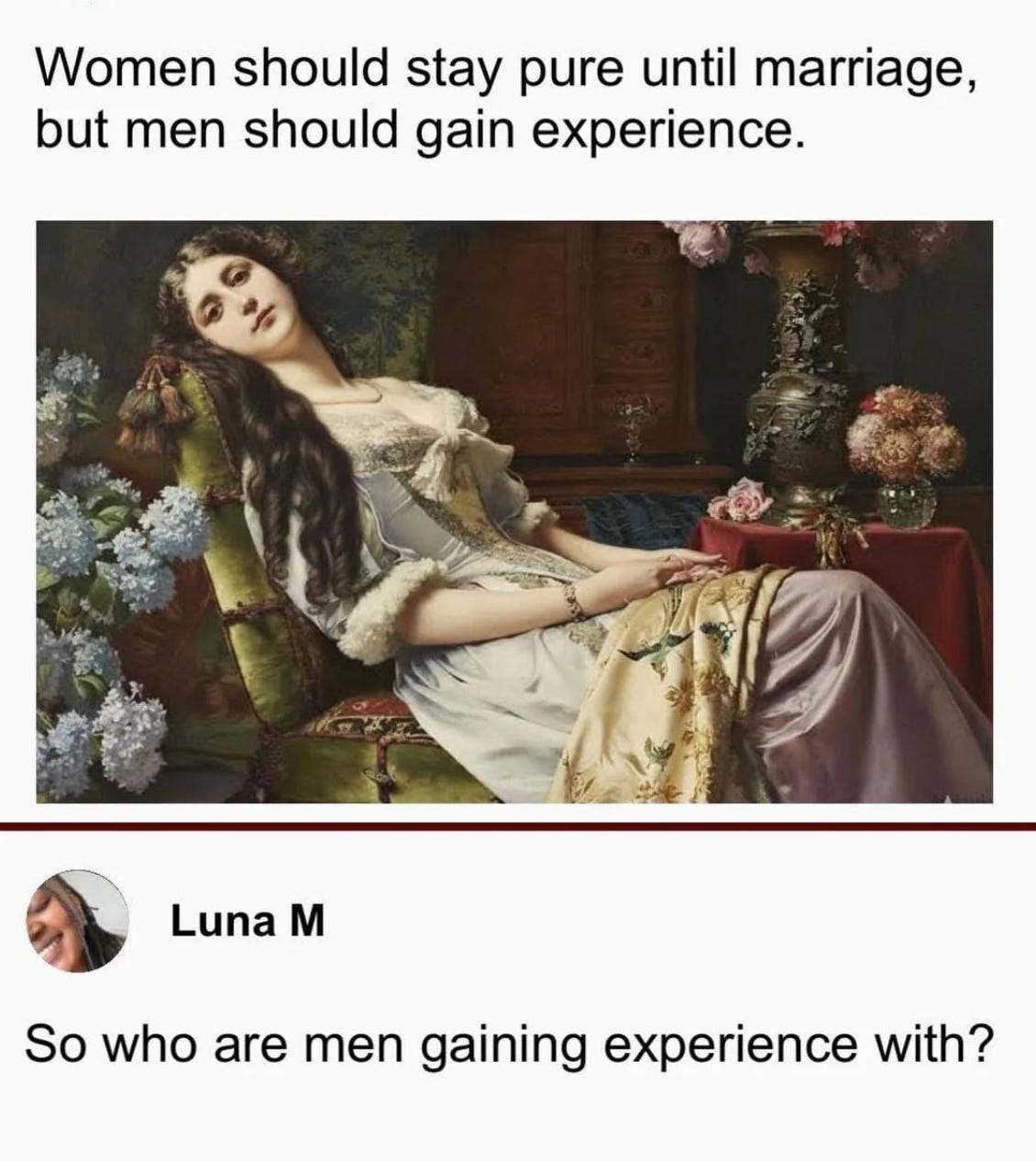
“Women should stay pure until marriage, but men should gain experience.”
In the comments, you can invariably find retorts along the lines of: “How are these men gaining experience if the women are all virgins?”
We’ll get there.
The ancient lie has never fully gone away—for most of human history, women have suffered the brunt of sexual double standards. But today, I’d like to bring this lie into conversation with an ancient writer who had a thing or two to say about it: the Apostle Paul.
Roman Purity Culture
In Paul’s day, a woman’s social value hinged on her sex life. (Or, more accurately, on the public’s perception of her sex life!)
A respectable Roman woman was expected to remain a virgin until she married and to remain faithful to her husband thereafter—and to publicly behave in ways that didn’t call her chastity (or purity) into question. Roman “purity culture” was exacting—even experiencing unwanted catcalling in public could damage a woman’s reputation. (A man could be sued for the damage he caused to a free woman’s reputation by harassing her on the street!)

Roman men, on the other hand, freely engaged in premarital and extramarital sex. Adultery, which was a crime, meant extramarital sex with a married woman. A man couldn’t commit adultery against his wife. He only committed adultery if he slept with another man’s wife. And the Romans weren’t unique on this point—this was pretty standard in the ancient world.
(It was also a crime—of lesser severity—to sleep with a respectable marriageable woman.)
“But wait,” you might ask. “If the women were sexually off-limits, who were the men sleeping with?”
But it’s an easy answer: Disposable women.1
All societies that demand chastity of women while permitting men to satisfy their lusts cultivate a class of honorless women—usually enslaved women and prostitutes—to sate men’s sexual appetites.
At times, the Romans could muster sympathy for enslaved prostitutes. But they rarely questioned the necessity of prostitution. These women played an indispensable role in society—with their bodies, they paid “the price of the chastity of freeborn wives [and] daughters.”2 The Romans couldn’t conceive of a world in which men must limit themselves. So they separated women into two categories: the chaste and the unchaste, the virgin/matron and the whore. Prostitution was integral to Roman “purity culture.”
In the second-century novel Leucippe and Clitophon, the respectable heroine maintains her virginity against all odds—as the heroines always do in these stories. In the course of the adventure, Leucippe meets her doppelgänger, an “ill-starred woman,” a prostitute who ends up beheaded in Leucippe’s place. The novel does not pretend that the prostitute deserves death in some moral sense. But neither does it question the ultimate fittingness of the outcome—fate has destined the honorable woman for one path and the honorless woman for another.3
Paul Would Like a Word
But Paul rejects the sexual double standard.
When he hears that Christian men in Corinth are visiting brothels, he sharply rebukes them (1 Corinthians 6:12-20). These men have internalized the norms of their culture and are dressing up their behavior in (incorrect) theological language, claiming that they have the right to go to brothels. After all, the body is disposable, so it doesn’t matter what they do with their bodies!
(Yet, imagine their reaction if their wives, daughters, or sisters claimed that same bodily freedom!)
In response, Paul does the unimaginable—he restricts male sexuality in the same way that female sexuality was restricted. Throughout 1 Corinthians 7, his longest treatment of sex and marriage, he pairs reciprocal statements about men and women. I cannot overemphasize how radical Paul was about marriage.
Each man should have his own wife? Each woman should have her own husband!
The husband has authority over his wife’s body? The wife has authority over her husband’s body!
For Paul, men and women have equal rights and responsibilities in their sexual behavior.
The Great Reversal
This might be striking enough on its own, a blow against the sexual double standards that have destroyed the lives of so many women over the centuries. But it’s especially arresting in light of Paul’s discussion of honor in the body of Christ in 1 Corinthians 12.
In this chapter, Paul begins with a discussion of spiritual gifts. Some members of the congregation are ranking spiritual gifts, especially speaking in tongues. But Paul insists that gifts are given by the Holy Spirit and that everyone—regardless of spiritual gift—is equally a member of the body, interdependent on every other member. This controversy over spiritual gifts may have fallen along socioeconomic lines. It’s possible that this was yet another division between the “strong” and the “weak” (which probably means “rich” and “poor,” respectively), and that speaking in tongues was especially practiced and valued by the wealthy.4
In any case, Paul takes the opportunity to extend the metaphor of the body of Christ to the question of social status.5 Paul writes, “Those members of the body that we think less honorable we clothe with greater honor, and our less respectable members are treated with greater respect” (1 Corinthians 12:23).
This contrasts sharply with typical Greco-Roman usage of the body as a metaphor for human society. Paul, with a sly wink, refashions a common metaphor into something radically topsy-turvy—“the genitals may seem to be the most shameful part of the body, but our very attention to them—our constant care to cover them and shield them from trivializing and vulgarizing public exposure—demonstrates that they are actually the most necessary of the body’s members, those with the highest status.”6
In short, Paul weaponizes an image of Roman hierarchy against itself while assuring the weak that they belong, fully and completely, to the body.
But Paul does not merely argue for flat equality but for a reversal of hierarchy, where those with the lowest worldly status receive the most honor.7 Driving the point home, he claims that this reversal comes from none other than God himself: “God has so arranged the body, giving greater honor to the inferior member” (1 Corinthians 12:24).
If, in the body of Christ, the weaker members are indispensable and the members thought less honorable are clothed with greater honor, then God does not simply make room for the low. He reverses the normal scales of human valuation. Neglected, devalued people aren’t pushed to the margins of the church’s concern but drawn toward its center.
And this ought to impact not just how the Corinthians see themselves spiritually, but how they treat each other in real, embodied ways—that “there may be no dissension within the body, but the members may have the same care for one another. If one member suffers, all suffer together with it; if one member is honored, all rejoice together with it” (1 Corinthians 12:25-26).
In this ordering of the Kingdom of God, an honorless woman sits atop the hierarchy. She is more valued than the men in the congregation, more honored than their respectable, chaste, freeborn wives and daughters. And if she possesses that much honor, it follows that there ought to be no class of dishonored women to satisfy the sexual appetites of men.
Paul makes chastity a male virtue, but he also strikes a blow at the very logic of dishonor that makes the Roman sexual system possible. For if an enslaved woman, too, is a woman of honor, she ought not be sexually available so that “better” women can remain chaste.
Instead, the men ought to exercise the same level of self-control as the women.
A Christian sexual ethic does not hold double standards.
Addendum: How, Then, Should We Live?
Chastity is an old-fashioned word, but I like it. In our current cultural moment, it comes with less baggage than some of its close synonyms. As Christians, men and women alike, we ought to live chastely—which, at the risk of oversimplification, means celibacy if unmarried and faithfulness if married—and teach others to do so.
(Lest I be misunderstood, our methods shouldn’t heap shame on people. We need to talk about these issues with immense care and remain pastorally sensitive in our approach. And after a person has repented, God looks forward, not backward. May we do likewise.)
And when we see Christians promote a sexual double standard—especially when we see it happen in person or among people we know in real life—let’s follow Paul as Paul follows Christ, and push back.
You can tell them, “The Apostle Paul would like a word.”
If you’d like to participate in the work I’m doing, here are the links!
Have a question or an insight? Agree or disagree with something I’ve said? Have another passage that you’d like to see me wrestle with in an upcoming post? Or just wanna hit “like”?
To support my writing financially, you can become a paid subscriber here on Substack or send a one-time gift on Buy Me a Coffee.
Think a friend (or your followers on social media) might find this post helpful?
ICYMI
Did Paul Blame Victims of Sexual Assault? (Part One)

In 1 Corinthians, Paul spends a lot of time talking about sex.
The Sacrifices of Isaac and Ishmael

In Genesis 22, God gives Abraham a soul-searing command: “Take now your son, your only son, whom you love, Isaac, and go to the land of Moriah, and offer him there as a burnt offering on one of the mountains of which I will tell you” (Genesis 22:2, NASB).
To keep this piece focused, I’ve limited the scope to male-female couplings, but I should acknowledge that enslaved boys were also used sexually within the home and pressed into prostitution.
Jennifer Glancy, Slavery in Early Christianity, 2nd ed. (Oxford: Oxford University Press; Minneapolis: Fortress Press, 2006), 56-57.
See discussion in chapter 1 of Kyle Harper, From Shame to Sin: The Christian Transformation of Sexual Morality in Late Antiquity, (Cambridge, MA: Harvard University Press, 2016),
Many of the divisions in the letter, including the questions of court cases, meat, and the love feast, seem to divide along the socioeconomic lines. See Dale Martin, The Corinthian Body, (New Haven: Yale University Press, 1995), xv-xviii.
Hays, First Corinthians, IBC, (Louisville, KY Westminster John Knox, 1997), 215-216. See also Witherington, Conflict and Community in Corinth: A Socio-Rhetorical Commentary on 1 and 2 Corinthians, (Grand Rapids, MI: Eerdmans, 1995), 258-260.
Dale Martin, “Tongues of Angels and Other Status Indicators,” JAAR 59.3 (1991), 567.
Martin, “Tongues of Angels and Other Status Indicators,” 567-569.
I love this article. I had never realized how radical these passages were, because I wasn't thinking in terms of a culture that assumed men should have unrestricted use of lower-honor women.
Also, about the passage about the wife and husband each having authority over the other's body. Some folks in the church weaponize this against women, interpreting it as "the wife can't deny the husband sexually because her body belongs to him." The NIV, in particular, uses the "belongs to" translation. My Greek dictionary translates εξουσιαζει as "have power or authority," which seems *very* different. I think it makes more sense in the context of the passage if Paul is saying "the wife can't just unilaterally decide she's done with sex forever, because *she has authority* over her husband's sex life as well, and she can't decide that for him."
But I hadn't realized how radical that was given that the culture this was written in assumed that the husband had complete authority to control his wife's sexuality -- but she had no authority at all to control his.
A further interesting thing is how a term beloved in evangelical purity culture (i.e., the man being the "Head of the Household") is a pagan legal description, and which has no basis in Scripture itself (with the closest thing being Paul's comment about the man being the head of the wife as Christ is head of the Church). I think many of these bad readings of Paul stem from a total cluelessness about the cultural context that he was fighting against. So, good work in helping to overturn those notions!
I wrote an essay some time ago (which I won't link, because it's tacky, but which I mention to show that I care about this subject) about how certain Trinitarian analogies can help us understand marriage in a more helpful manner. I have been meaning to return to critiques of purity culture (but haven't had a chance yet). This is a good reminder for me to do so!